
What Claims Can Follow a Dallas Work Truck Collision?
A collision involving a commercial truck can disrupt a workday and raise more than one legal question. If you were driving for work, riding in a company vehicle, or doing a job task when the crash happened, a Dallas work-related truck accident claim may involve workers’ compensation and a separate claim against someone outside your employer. Those processes have different purposes, reporting routes, and evidence needs. One does not necessarily replace the other.
Husain Law helps people understand the issues that may arise after a serious truck crash. This article explains how the two potential claims differ, what to document and report, and why it can be important to consider each timeline separately. The specific options depend on facts such as who employed you, whether workers’ compensation coverage applies, and who may have contributed to the collision.
How a Dallas work-related truck accident claim can involve two paths
Workers’ compensation and a third-party injury claim are not the same process. Workers’ compensation, when available, generally concerns benefits connected to an employee’s work-related injury. A third-party claim may seek damages from a person or business other than the employer if evidence supports that party’s legal responsibility for the crash.
For example, a worker may be hurt while making a delivery when a truck operated by an outside carrier collides with the worker’s vehicle. The worker could have questions about workplace injury benefits and, separately, whether the outside driver or another business may be legally responsible. A claim is not established just because a crash occurred; responsibility depends on the facts and applicable law.
Texas has a distinctive workers’ compensation system. Many private employers may choose whether to carry workers’ compensation insurance, while some employers are subject to different requirements. If an employer does not subscribe to workers’ compensation, the options and legal issues can differ. The Texas Department of Insurance’s Division of Workers’ Compensation administers the state workers’ compensation system. Coverage status and the details of a particular workplace injury matter, so a general description cannot determine which benefits or claims apply.
Why one claim does not automatically replace the other
Workers’ compensation and a third-party claim can address different legal relationships. A benefits process does not, by itself, answer whether an outside driver, trucking company, maintenance provider, or another party contributed to the collision. Conversely, investigating a third-party claim does not automatically complete an employer’s injury-reporting process.
What to report and document after an on-the-job truck crash
A work-related collision can create separate reporting questions. An employee may need to notify an employer or follow workplace procedures, while a potential third-party claim may call for documenting how the crash happened and identifying other involved parties. The process and deadlines can depend on the circumstances and applicable rules.
Useful information may include:
- The date, approximate time, and location of the crash, including whether it occurred during a work assignment.
- The names and contact information of witnesses, drivers, and any responding agency, if available.
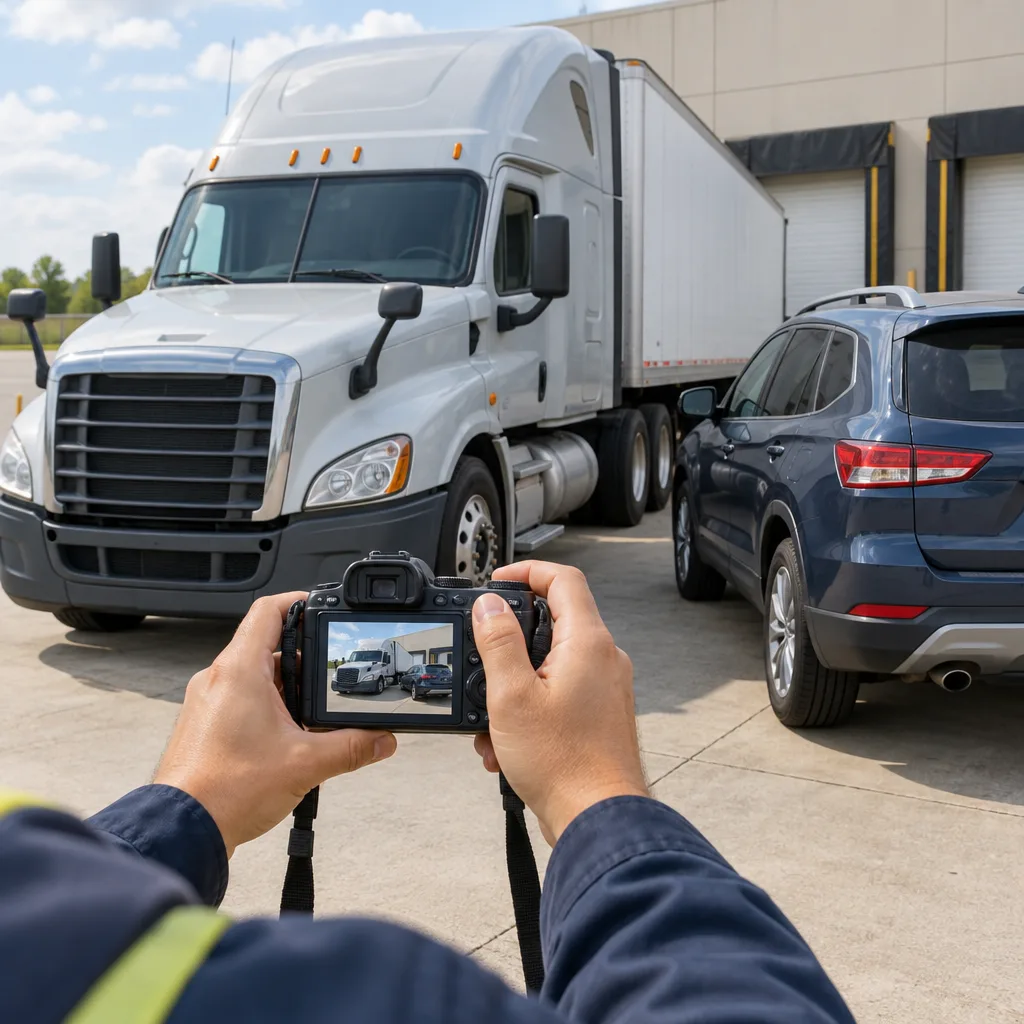
- Photographs or other available scene evidence, vehicle damage, and details about the vehicles involved.
- Work-related records, such as the assignment, route, schedule, or communications about the trip.
- Records related to the injury and its effects, kept and shared in accordance with applicable privacy and claim procedures.
For practical scene and reporting considerations, see these Dallas semi-truck crash reporting and evidence steps. Workplace reporting and crash documentation are related, but they are not necessarily interchangeable.
Evidence about the truck may also matter to a separate investigation. Depending on the vehicle and what information is available, electronic data may help show vehicle activity before or during a collision, such as braking or speed. It is distinct from employment and injury records, and it may not be available indefinitely. Learn more about electronic data from a Dallas semi-truck crash and why preservation can be a consideration.
Separate responsible parties, deadlines, and claim questions
A third-party claim requires more than showing that a worker was injured on the job. The facts must support a legal basis for holding someone other than the employer responsible. Depending on the collision, potential parties for investigation could include the truck driver, the carrier, a vehicle owner, or a maintenance provider. Whether any of them may be liable depends on the evidence and the applicable law. This overview of Dallas truck accident claims against a trucking company explains why the driver may not be the only possible third party to consider.
The processes may also have different timelines. Reporting an injury at work or pursuing benefits does not necessarily preserve a lawsuit against an outside driver or company. Texas deadlines for a third-party injury claim can depend on the circumstances, and exceptions or other rules may affect a particular case. A guide to Texas deadlines for filing a Dallas truck accident claim can provide general context, but it cannot determine a deadline for an individual situation.
If workers’ compensation benefits are paid and a third-party recovery is later pursued, reimbursement or related rights may arise. The way those issues are handled can depend on the claim, coverage, and applicable Texas law. It is prudent not to assume that any payment, filing, or conversation in one process resolves the other. A lawyer familiar with truck crashes and the relevant workplace issues can evaluate how the questions may intersect.
Frequently Asked Questions
Does a crash during a work errand count as work-related?
It may, but the answer depends on what the employee was doing, the work arrangement, and the circumstances of the trip. A crash during a scheduled delivery may raise different questions from a personal detour or commute. The label alone does not settle coverage or eligibility. The employer’s reporting process and the facts surrounding the assignment may both be relevant when the situation is reviewed.
What if my employer does not have workers’ compensation insurance?
Texas allows many private employers to choose not to subscribe to workers’ compensation, but that can change which rules and options apply. An employer’s coverage status should not be assumed from its size or industry. A workplace injury may still raise other legal questions, including whether a third party contributed to the collision. A licensed Texas attorney can explain how the employer’s status may affect a particular situation.
Can the truck driver’s employer be involved in a separate claim?
Possibly. Depending on the evidence, a trucking company or another business may be considered in addition to the driver. A company’s connection to the truck or driver does not automatically establish legal responsibility. Investigators may examine the relationship between the parties and relevant records. Responsibility is fact-specific, so identifying a potential party is an early question, not a conclusion about liability.
Could a workers’ compensation payment affect money from a third-party claim?
It can raise coordination or reimbursement questions. If benefits have been paid and a third-party claim is pursued, applicable Texas rules and the facts may affect how the claims interact. The details can depend on the type of benefit, the parties involved, and the status of the claims. For that reason, workers should not assume that any eventual recovery is calculated without considering prior benefit payments or related rights.
How Husain Law Can Help
Husain Law is dedicated to helping injured workers understand the separate questions that can follow a truck collision on the job. Our team can evaluate whether the available facts point to a potential third-party claim, what evidence may be relevant, and which issues may need to be coordinated with a workplace benefits process. No two crashes have the same facts, and an initial review cannot guarantee a particular result. To discuss a Dallas truck crash and explore your options, contact Husain Law for a free consultation or case evaluation. You can also review information about Dallas truck accident lawyers and the issues they may evaluate.
The information in this article is for educational purposes only and does not constitute legal advice. Contact a qualified attorney licensed in Texas for advice specific to your situation; laws vary by location and may have changed since publication.