
Why Are Dallas Wide-Turn Crashes Hard to Reconstruct?
A truck begins a turn at a Dallas intersection, and nearby traffic may have only moments to react. After a collision, people can disagree about where the truck was positioned, how wide its path became, or when another vehicle entered the space beside it. A Dallas wide-turn truck accident can be hard to reconstruct because the vehicles’ movements, blind areas, and changing traffic conditions all matter. Husain Law helps readers understand the kinds of evidence that may clarify a collision without treating any single account as conclusive. This article explains how truck dimensions and turning paths complicate an investigation, what photographs, witnesses, camera footage, and electronic records may show, and why different interpretations of the same turn can arise. The available evidence depends on the crash location and what was preserved.
Why Dallas Wide-Turn Truck Accidents Are Difficult to Reconstruct
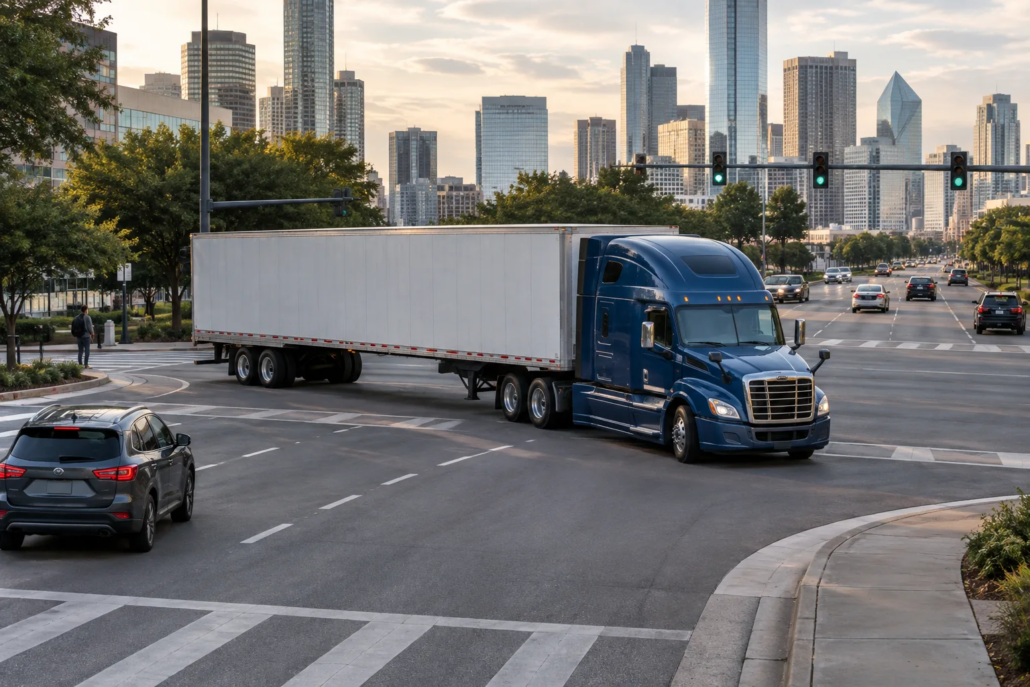
A large commercial truck does not move through an intersection like a passenger car. Depending on its length, wheelbase, trailer, and configuration, a truck may need substantial room to turn. The rear wheels can follow a different path from the front wheels, while the trailer may track closer to the inside of a turn. A truck may also swing outward before turning, making its path less obvious from a single photograph or a driver’s brief view.
The turning path changes what the scene can show
Reconstruction may require working out where the truck was before, during, and after the turn. Investigators may consider tire marks, debris, damage locations, the final resting positions of vehicles, and the layout of lanes, curbs, and nearby driveways. Those clues can shift or disappear as traffic moves and the scene is cleared. A photo taken from one angle may show the impact area but not the truck’s full approach or the space available to other vehicles.
Sightlines and nearby traffic complicate the picture
Mirrors, cab structure, trailer position, and other vehicles can affect what a driver could see at a particular moment. Meanwhile, cars, bicycles, and pedestrians may approach from several directions. In Dallas, a busy multilane intersection or a commercial driveway can create a crowded scene where vehicle positions change quickly. Understanding those sightlines takes more than measuring the turn: it also requires considering what each person could observe from their location.
What Evidence May Clarify a Dallas Truck Turning Accident
Reconstruction often draws on several kinds of information rather than one decisive clue. Each source has limits, and details may be incomplete or inconsistent. A useful investigation compares accounts with physical evidence and the timing of events.
- Scene photographs: Images may document lane markings, curb lines, vehicle damage, debris, road conditions, and where vehicles stopped. Wider views can help show the intersection layout; close views may capture damage or contact points.
- Witness accounts: People who saw the truck approach or turn may describe its position, speed, signals, or nearby traffic. Their vantage points and opportunity to observe can affect how much detail they recall.
- Camera footage: Business, residential, traffic, or vehicle cameras may capture the approach, turning arc, nearby vehicles, or impact. Availability, camera angle, image quality, and how long footage is retained can vary. Similar to ways surveillance footage can help identify a truck, video may provide useful context even when no vehicle left the scene.
- Electronic truck records: Depending on the vehicle and systems involved, electronic truck records that may clarify vehicle actions could offer information about timing, speed, or braking. They are not a complete reconstruction by themselves and should be assessed alongside scene evidence and witness accounts.
Prompt documentation may help preserve details before they change. General steps to take after a semi-truck crash in Dallas can include recording the location and identifying potential witnesses, when circumstances allow. No one should put themselves in danger to gather evidence.

Why Accounts of the Turn Can Differ
A turning collision can produce competing descriptions even when people are acting in good faith. One driver may remember the truck crossing into a neighboring lane; the truck operator may describe a wide arc needed to complete the turn. A witness standing near the corner may see the front of the cab but not the trailer’s path. Another person may arrive after vehicles have moved. These differences make it important to distinguish direct observations from later conclusions.
The physical setting can also complicate interpretation. A vehicle’s damage may indicate where contact occurred, but damage alone may not establish the entire sequence. Road markings, signal timing, traffic flow, obstructions, and the positions of other road users can affect the analysis. In Dallas County, as elsewhere in Texas, the evidence may become important if the people involved dispute how the crash happened. General information about how Texas comparative fault can affect a truck crash dispute can help explain why details about lane position, speed, braking, and right-of-way may matter; the evidence does not automatically determine responsibility.
A careful review asks what each source actually shows, what it cannot establish, and whether independent sources support the same timeline. The responding agency’s crash report may record observations and statements, but it is one part of the available information, not necessarily a full technical reconstruction. Procedures and legal rules can vary, and Texas law may change.
Frequently Asked Questions
Why can a truck’s trailer follow a different path during a turn?
A trailer’s wheels do not trace the same route as the truck’s front wheels. The trailer can track closer to the inside of a turn, while the cab may swing outward to make room. The amount of space needed depends on the vehicle’s dimensions and configuration. That difference can make it difficult to determine where the truck traveled using only one viewpoint or a final vehicle position.
Can photos taken after a Dallas intersection crash help explain the turn?
They may help document vehicle positions, damage, debris, lane markings, curbs, and visibility conditions. A wider scene view and closer images can each provide different information. Photos generally capture only a moment and angle, however, and vehicles or road conditions may have changed before an image was taken. Their value depends on context and comparison with other evidence.
What if witnesses describe the truck’s movement differently?
Different accounts may reflect where each witness was standing, what was visible, and how long they observed the event. Investigators can compare those descriptions with physical evidence, photographs, video, and other available records. A disagreement does not by itself establish that a witness is wrong or that one version is conclusive. The full circumstances matter.
Does camera footage always show how a wide-turn crash happened?
No. Footage may not exist, may not have been retained, or may show only part of the intersection. A camera’s angle, distance, obstructions, and image quality can limit what it reveals. When available, video may help establish timing or vehicle movement, but it is generally most useful when considered alongside scene evidence and other accounts.
How Husain Law Can Help
Husain Law is dedicated to helping people understand the issues that can arise after a commercial truck collision. The firm can review the circumstances, discuss what evidence may be relevant, and explain potential legal options based on the available information. A wide-turn crash investigation may involve several sources that need to be considered together, and the significance of any evidence depends on the facts. If you have questions about a truck collision in Dallas, contact Husain Law to request a free consultation or case evaluation. The firm is ready to evaluate your situation and discuss how it may be able to help.
The information in this article is for educational purposes only and does not constitute legal advice. Contact a qualified attorney licensed in Dallas, Texas for advice specific to your situation.

